
Kilimanjaro Trek Park Fees: A Detailed Guide

If you’re a mountaineer lover, here is our detailed guide on Kilimanjaro Trek Park Fees. Find out what to expect on this extraordinary mountain adventure.Embarking on a Mount Kilimanjaro expedition involves costs, with a significant portion attributed to fees payable to the Kilimanjaro National Parks Authority (KINAPA), the overseeing body of the park. These fees contribute to around 75% of the overall trek expenses, making them a crucial aspect to understand. In this article, we’ll delve into these fees, explain their components, offer insights on fee calculation, highlight discounts available, and provide valuable information about the payment process.

A Quick Glance at Fees for Different Routes – Kilimanjaro Trek Park Fees

The following outlines the fees inclusive of both charges and taxes for different routes:

  • Machame 6 days: $814.20 per person
  • Machame 7 days: $955.80 per person
  • Lemosho 7 days: $955.80 per person
  • Lemosho 8 days: $1097.40 per person
  • Marangu 5 days: $719.80 per person
  • Marangu 6 days: $873.20 per person
  • Rongai 6 days: $814.20 per person
  • Rongai 7 days: $955.80 per person
  • Umbwe 6 days: $814.20 per person
  • Umbwe 7 days: $955.80 per person
  • Northern Circuit 8 days: $1097.40 per person
  • Northern Circuit 9 days: $1239.00 per person

Understanding the Fee Components – Kilimanjaro Trek Park Fees

The fees comprise different elements, with their calculations dependent on the number of days and nights spent within the park. Let’s delve into the main constituents:

Conservation Fees – These fees contribute to the preservation of the national park. Each day in the park incurs a fee of $70. To illustrate, a 7-day Lemosho route would involve conservation fees amounting to $490 ($70 x 7 days).

Camping Fees – Most routes entail camping at designated sites, complete with restroom facilities. A nightly camping fee of $50 is applicable. For instance, camping over 6 nights on a 7-day Lemosho trek would equate to $300 ($50 x 6 nights).

Hut Fees – The Marangu route involves hut accommodations instead of tents. You’ll be charged $60 for each night spent in a hut. On a 5-day Marangu route, the total hut fees would sum up to $240 ($60 x 4 nights).

Rescue Fees – In case rescue services are necessary, these fees cover associated expenses. The rescue fee amounts to $20 per trekker for each trek.

Crater Camping Fees – Opting to camp within the crater incurs an additional cost of $100 per trekker per night.

Guide and Porter Entrance Fees – Entrance fees for guides, cooks, and porters must also be covered. The fee stands at $2 per person in the group.

Value Added Tax (VAT) – A government-imposed Value Added Tax (VAT) of 18% is applicable to all mentioned fees.

Calculating the Fees

Now, equipped with an understanding of the fee components, you can perform fee calculations with ease. Consider two examples:

Example 1: 6-day Machame route

  • Conservation fees: $70 x 6 days = $420
  • Camping fees: $50 x 5 nights = $250
  • Rescue fees: $20
  • Total (before taxes): $420 + $250 + $20 = $690
  • VAT (18%): $124.20
  • Total (including taxes): $690 + $124.20 = $814.20

Example 2: 5-day Marangu route

  • Conservation fees: $70 x 5 days = $350
  • Hut fees: $60 x 4 nights = $240
  • Rescue fees: $20
  • Total (before taxes): $350 + $240 + $20 = $610
  • VAT (18%): $109.80
  • Total (including taxes): $610 + $109.80 = $719.80

Payment of Fees – Kilimanjaro Trek Park Fees

The prices presented upon inquiry encompass all fees and taxes, ensuring a transparent cost structure. Rest assured, we handle fee payment to the park and acquisition of the required permits on your behalf.

Available Discounts

Specific groups can benefit from park fee discounts, including children, Tanzanian residents, and citizens of East African countries.

  • Children aged 5-15: Reduced fees for conservation and camping. Hut and rescue fees remain standard.
  • Children under 5: No conservation or camping fees. Hut and rescue fees apply.
  • Residents/Expatriates: Tanzanian residents receive discounted conservation fees; other fees remain unchanged.
  • East African Citizens: Discounts available for citizens of Tanzania, Kenya, Uganda, Burundi, Rwanda, and South Sudan. Proof of citizenship via passport is required.

In Summary

Our prices align with the park’s stipulated fees, without any hidden extras. When exploring our website, the displayed prices include all fees and taxes, ensuring complete transparency about the overall cost.

Important Update

As of October 2018, direct payment of fees at the park gate on the trek’s first day is no longer feasible. Only authorized tour operators can make payments via the online system.

If you liked our Kilimanjaro Trek Park Fees: A Detailed Guide, you might also like to read our Training for Climbing Kilimanjaro.

What Do You Need to Carry on Mount Kilimanjaro?

If you’re a brave mountaineer and adventure lover, read below what to expect and carry on Mount Kilimanjaro!

When gearing up for your Mount Kilimanjaro adventure, you’re responsible for carrying the items you’ll need during the day before you reach your next campsite. Our skilled porters will take care of carrying your other belongings. A backpack with a volume capacity of around 30 liters (2000 cubic inches) works well – not too big, not too small.

Climbers should prepare their daypacks or backpacks, while other belongings go in a duffel bag for the porters to handle. Your daypack’s contents should be tailored to your daily needs.

The rule of thumb is to carry only what’s necessary for the day. For instance, you don’t need cold weather gear in the rainforest. Likewise, bug spray isn’t relevant at higher elevations.

Essential Items for Your Day Pack on the Kilimanjaro Trek – What to Carry on Mount Kilimanjaro

Once you’re equipped with your complete trekking attire, including a hat, shirt, underwear, hiking pants, socks, and boots, let’s explore what you should pack in your daypack.

Protection from the Elements:

  • Sunglasses for eye protection
  • Buff or Neck Gaiter (optional)
  • Warm Knit Hat
  • Soft Jacket (fleece or soft-shell)
  • Waterproof Jacket (breathable with hood)
  • Thin Gloves
  • Waterproof Pants (breathable)
  • Trekking poles (optional, but recommended, especially for the summit)

Hydration and Energy:

  • Water Bottle (Nalgene, 32 oz.)
  • Water Bladder (Camelbak type, 3 liters)
  • Snacks (lightweight, high calorie, high energy – optional)
  • Electrolytes (powder or tablets – optional)

Essential Miscellaneous:

  • Camera (with extra batteries – optional)
  • Lip Balm
  • Sunscreen
  • Hand Sanitizer
  • Toilet Paper
  • First Aid Kit
  • Various Bags

These items form the core of what you’ll need in your daypack. Keep in mind that specifics might change based on factors like travel time to camp, terrain, weather conditions, and your personal requirements.

Feel free to consult your guide if you’re unsure about your packing choices. Their expertise ensures you’re well-prepared for your Kilimanjaro expedition.

How to Pack Your Day Pack Effectively – What to Carry on Mount Kilimanjaro

For an organized daypack, avoid haphazardly tossing items, risking them falling out or getting lost. Instead, use a strategic approach by using plastic bags, dry bags, or stuff sacks to categorize and secure your belongings. For instance, group small bottles like prescriptions, sunscreen, lip balm, and hand sanitizer within a zip-lock bag. Similarly, organize snacks in a separate bag, while clothing accessories like hats, gloves, and neck gaiters can go into a stuff sack.

Balancing the load is key

Place heavier items, such as water bottles, near your back’s center to maintain balance aligned with your spine. Avoid unevenly placing heavy items, which could lead to awkward tilting. If available, use compression straps to secure items and prevent shifting as you walk.

Consistency is crucial

Keep your items in the same spots, whether in the main compartment, side pockets, or pant pockets. This ensures easy access without searching for essentials.

If you liked our What Do You Need to Carry on Mount Kilimanjaro, you might also like to read our Toilets on Kilimanjaro: What to Expect.

What Belongs in Your Duffel Bag – What to Carry on Mount Kilimanjaro?

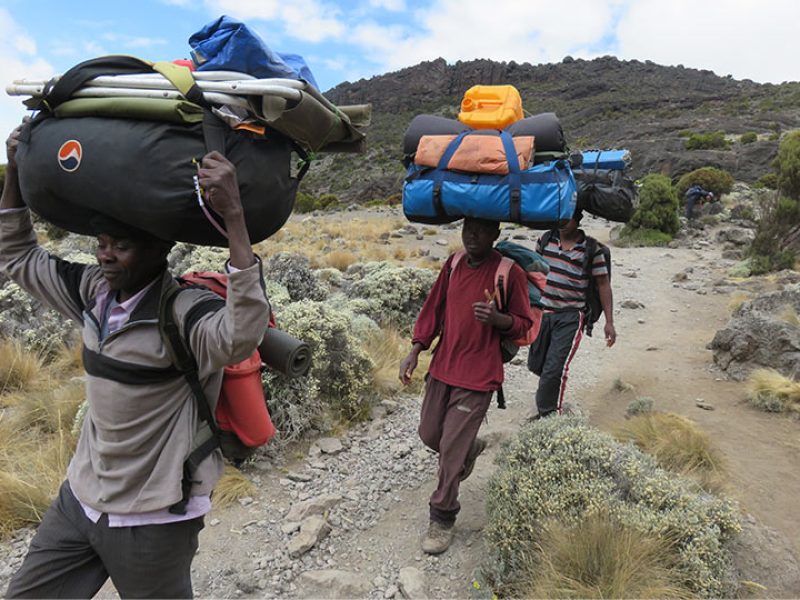
All items that don’t go in your daypack should be packed in your duffel bag.Porters will carry your duffel bag between campsites. As climbers set off in the morning, porters remain behind to pack up tents and tidy the campsite. They then move ahead, reaching the next campsite ahead of climbers. Here, they set up camp, cook, and provide water. Climbers generally reconnect with their porters at the next overnight stop, accessing their belongings carried by the porters only at day’s end.

The duffel bag weight limit, set by Kilimanjaro park authorities, is 15 kilograms. Use plastic bags or dry bags to keep belongings organized and dry. While a backpack is acceptable, porters prefer duffel bags due to how they carry loads on their heads, making duffel bags more suitable for the journey.

Toilets on Kilimanjaro: What to Expect

Here is our guide to Toilets on Kilimanjaro. Read the text provided below and find out everything you need to know.In the realm of using restrooms, our expectations are usually centered around comfort and privacy. However, the scenario shifts when you embark on a trek up Mount Kilimanjaro. This article will provide insights into the available toilet facilities on the mountain, spanning from basic campsite setups to options for private portable toilets.

Navigating the Call of Nature – Toilets on Kilimanjaro

First and foremost, let’s ease your concerns. There are public toilets at every campsite along the Kilimanjaro route. Yet, it’s essential to adjust your expectations. Leave aside thoughts of porcelain commodes with lockable doors and sinks equipped with soap dispensers. Picture instead a wooden structure (often lacking a door, let alone a lock) enclosing a deep hole in the ground.

Prepare yourself for squatting and minimal privacy. Although the Kilimanjaro National Park team diligently maintains these facilities, the task is challenging due to the sheer number of climbers using them. Consequently, the odor emanating from Kilimanjaro’s communal ‘long drop’ toilets can be potent, making the experience rather unpleasant and unsanitary.

Is a Private Toilet an Option?

Indeed, we offer “portable private toilets.” These are fully equipped chemical toilets enclosed within their own discreet tent for complete privacy (although not necessarily soundproof). These portable restrooms are reserved exclusively for your group’s use and are set up and accessible solely at the campsite.

The porters, responsible for cleaning, upkeep, and transportation, ensure that your restroom breaks remain hygienic and private.

Addressing Mid-Trek Bathroom Needs – Toilets on Kilimanjaro

For minor needs like urination, a practical solution is to find a private spot behind a tree or bush for a brief moment. Informing your guide can help prevent any awkward encounters. As you ascend beyond the tree line, finding suitable cover becomes more challenging. Larger shrubs may offer privacy, and if not, boulders or rock formations could serve as alternatives.

A more effective strategy is carrying a container to empty at the next campsite. Specialized products like Shewee for women and Peebol for everyone, available on platforms like Amazon, serve this purpose. “Personal toilet” kits designed for events like festivals can also work well for Kilimanjaro treks. Having a container proves useful during the day’s hike and nighttime when leaving the campsite is less appealing.

Dealing with Defecation on the Trail

For defecation needs, locate a secluded area as discussed earlier. Leaving waste behind is unacceptable. Disposable plastic bags can be carried for waste collection. Additionally, having toilet paper and hygienic wet wipes for cleanup is crucial.

Remember: Proper disposal is key. After cleaning up, place everything in a plastic bag (consider using double bags), secure it tightly, and take it to the next campsite. The porters will handle it from there.

How Does a Long Drop Toilet Function?

A long drop toilet, also known as a pit latrine, collects human waste in an underground hole beneath the toilet. It can operate with or without flowing water. The design aims to reduce disease spread and the transfer of pathogens by flies.

Extending the Long Drop

The maximum depth for a long drop toilet’s hole is 1 meter from the ground level. Once the hole is filled up to 330mm, you’ll need to dig a new one. After filling, it’s essential to cover the long drop with soil completely.

If you liked our Toilets on Kilimanjaro: What to Expect, you might also like our What Do You Need to Carry on Mount Kilimanjaro?

Internet and Mobile Reception on Mount Kilimanjaro

Climbing Mount Kilimanjaro is an unforgettable adventure, but many trekkers wonder whether they can stay connected during the journey. Fortunately, mobile network coverage has improved significantly in recent years, allowing climbers to access phone service and mobile internet at many points along the mountain. However, reception still varies depending on the route, altitude, weather conditions, and network provider.

Is There Mobile Reception on Mount Kilimanjaro?

Yes, there is mobile reception on Mount Kilimanjaro, although coverage is not available everywhere. Tanzania’s major mobile operators have expanded their networks around the mountain, and you can often make calls, send messages, and use mobile data from many camps.

Reception is generally stronger on the lower and middle sections of the mountain. As you climb higher, signal strength becomes less predictable, particularly near remote camps or on steep volcanic slopes.

Which Mobile Networks Work Best?

Several Tanzanian providers offer coverage around Mount Kilimanjaro, including:

  • Vodacom Tanzania
  • Airtel Tanzania
  • Halotel
  • Yas (formerly Tigo)

Among these, Vodacom and Airtel are widely regarded as providing the most reliable coverage for trekkers. Purchasing a local SIM card before your climb is often the most affordable option if you plan to stay connected.

Can You Access Mobile Internet?

Yes. In many locations, you can access 3G, 4G, and in some lower areas even faster mobile data services. This allows you to:

  • Send WhatsApp messages
  • Share photos with friends and family
  • Check emails
  • Use weather applications
  • Access GPS or mapping apps

Keep in mind that internet speeds may decrease at higher elevations or during periods of heavy network usage.

Where Is Reception Strongest?

Mobile coverage is usually strongest:

  • At the park gates
  • During the first days of the trek
  • Around many overnight camps
  • At several viewpoints with clear lines of sight

Reception may become weaker:

  • Inside deep valleys
  • On exposed volcanic ridges
  • During poor weather
  • Near the summit where network availability can fluctuate

Although some climbers manage to send messages from Uhuru Peak, you should not rely on having a stable connection at the summit.

Charging Your Devices

Even if you have network coverage, keeping your devices powered is another challenge. Most mountain camps do not have public electricity, so you should bring:

  • A high-capacity power bank
  • Spare charging cables
  • A lightweight solar charger (optional)
  • Extra batteries for cameras

Cold temperatures reduce battery performance dramatically. Keep your phone and power bank inside your sleeping bag or an inner jacket pocket overnight to preserve battery life.

Should You Expect Continuous Connectivity?

No. While reception has improved considerably, Kilimanjaro remains a high-altitude wilderness. Network interruptions are normal, and there may be extended periods without service.

Many climbers actually appreciate these breaks from constant communication. Disconnecting from everyday life allows you to fully experience the mountain’s breathtaking landscapes, changing ecosystems, and the shared adventure with your guides and fellow trekkers.

Safety Communication

Professional mountain guides carry communication equipment and maintain contact with park authorities when necessary. Emergency procedures do not rely solely on personal mobile phones, so you should always follow your guide’s instructions if assistance is required.

Having your own phone with local service can still provide reassurance, allowing you to update loved ones whenever reception becomes available.

Tips for Staying Connected

To maximise your chances of maintaining a connection during your climb:

  • Purchase a local Tanzanian SIM card before starting the trek.
  • Download offline maps and important documents in advance.
  • Charge all devices fully before entering the park.
  • Carry at least one high-capacity power bank.
  • Enable airplane mode when you do not need a signal to conserve battery life.
  • Keep electronic devices warm during cold nights.
  • Inform family that communication may be intermittent throughout the expedition.

Final Thoughts

Mobile reception on Mount Kilimanjaro is far better today than many travellers expect. While you should not count on uninterrupted service throughout your climb, most trekkers can make calls, send messages, and access the internet at various points along the route. By preparing with a local SIM card, sufficient backup power, and realistic expectations, you can enjoy the best of both worlds—remaining connected when possible while fully embracing the remarkable experience of Africa’s highest mountain.

Climbing Kilimanjaro: Month-Wise Summary

If you’re a brave mountaineer and adventure lover, here is our Climb Kilimanjaro Month-Wise Summary! Read the info provided below. We hope to see you soon on one of our Kilimanjaro Routes!

Embarking on a Kilimanjaro expedition is a choice heavily influenced by the time of year. Each month presents its own unique blend of advantages and challenges. Let’s explore the ideal months for scaling this iconic peak, diving into the specifics for each month.

Climb Kilimanjaro – A Monthly Review

January

Climbing Kilimanjaro in January offers a promising start to the year. The weather is warmer, with fewer rain showers and clouds obstructing the scenery. However, keep in mind that January attracts a larger number of climbers seeking the same conditions. Despite the generally favorable weather, it’s essential to remain prepared for the unpredictability that comes with any mountainous terrain.

February

February emerges as a prime window for conquering Kilimanjaro. This month offers clear skies, warmer temperatures, and less cloud cover compared to others. The favorable weather conditions come with a caveat—dusty trails. Dry weather prevails, often covering trekkers and their surroundings in fine dust. Be equipped with necessary gear, including a buff, to counter the effects of dust and variable weather.

March

March introduces a challenge to Kilimanjaro climbers. The mountain becomes enshrouded in clouds, experiencing frequent rainfall and even snowfall. Trekking Kilimanjaro during March means navigating slippery terrains and contending with reduced visibility. With fewer climbers on the mountain, the experience might offer solitude, but the wet and potentially stormy conditions make it a demanding journey.

April

April offers a unique experience for those willing to embrace wet conditions. While clear skies can provide breathtaking views, the rain arrives almost daily. Thunderstorms are common, and the dampness can be pervasive. Climbing Kilimanjaro in April requires a strong willingness to endure the elements and face challenges, including potential discomfort from wet clothing and gear.

May

May might surprise climbers with drier conditions than usual, although traditionally it’s considered one of the wetter months. Recent years have seen a shift, with May offering fewer showers. Despite this, the unpredictable weather patterns can’t be overlooked. Rainfall remains frequent, and caution is advised. May provides fewer crowds, but the damp and wet environment may not be appealing to everyone.

June

The rainy season sometimes extends into early June, occasionally resulting in colder temperatures at higher elevations. However, generally, June signifies drier weather and warmer conditions. While the number of climbers increases compared to February, August, and September, June offers clear skies, making it an ideal month for witnessing stunning sunrises and sunsets.

July

July brings a surge in the number of climbers. School vacations and favorable weather contribute to the higher footfall. Although colder temperatures prevail higher up, the overall weather conditions are favorable. The advantage of July lies in the increased chances of clear mountain views, reduced rain in the rainforest, and overall good climbing conditions.

August

August emerges as another desirable month for Kilimanjaro ascents. Dry and clear weather characterizes this period, though dusty trails might result from windy conditions. The warmth of August complements the generally clear skies, offering unobstructed mountain views. Despite the dust, the overall experience is positive, and Kilimanjaro’s unique landscape comes to life.

September

September stands as another prime choice for Kilimanjaro expeditions. Warmer temperatures at higher altitudes and varying trekker numbers create a balanced environment. Opting for a longer acclimatization program in September is advisable, allowing you to bypass crowds and increase summit success rates. The reliable weather, combined with dryer conditions, makes this a rewarding time to conquer Kilimanjaro.

October

October extends favorable conditions for Kilimanjaro climbers. Higher elevations enjoy warmer temperatures, accompanied by slight cloud cover toward the end of the month. Climbers seeking a stable experience should consider the early part of October. Generally, this month provides a comfortable atmosphere for ascending the peak.

November

November presents a set of challenges, primarily due to increased rainfall. This month can experience mini rainy seasons, resulting in daily rain and compromised visibility. Climbing Kilimanjaro in November tests your readiness to tackle wet and potentially unstable conditions. While snowy scenes above 5,000m/16,400 feet are common, overall views might be obstructed due to poor visibility.

December

December remains a viable time for Kilimanjaro expeditions. Climbing at the beginning of December and over the Christmas period is gaining popularity. While weather conditions vary from year to year, December typically offers decent weather. However, stability might not be as consistent as in other months. The choice to climb in December depends on your readiness to adapt to changing weather patterns.

If you liked our Kilimanjaro Climb: Month-Wise Summary, you might also like our Internet and Mobile Reception on Mount Kilimanjaro.

Kilimanjaro FAQ

Packing list for Kilimanjaro is one of the most important steps on the way to a successful climb. You will find online number of recommendations, however, most of them are not essential.

Continue reading

Kilimanjaro Guides & Porters

Packing list for Kilimanjaro is one of the most important steps on the way to a successful climb. You will find online number of recommendations, however, most of them are not essential.

Continue reading

Insider Tips & Advice

When you decide to travel to Tanzania, you should be aware of certain things to know before going to Tanzania. We here do provide you with the travel tips to Tanzania which will be useful for your travel to Tanzania.

Continue reading

Recommended Packing List

Packing list for Kilimanjaro is one of the most important steps on the way to a successful climb. You will find online number of recommendations, however, most of them are not essential.

Continue reading